A single source of truth begins in the data model
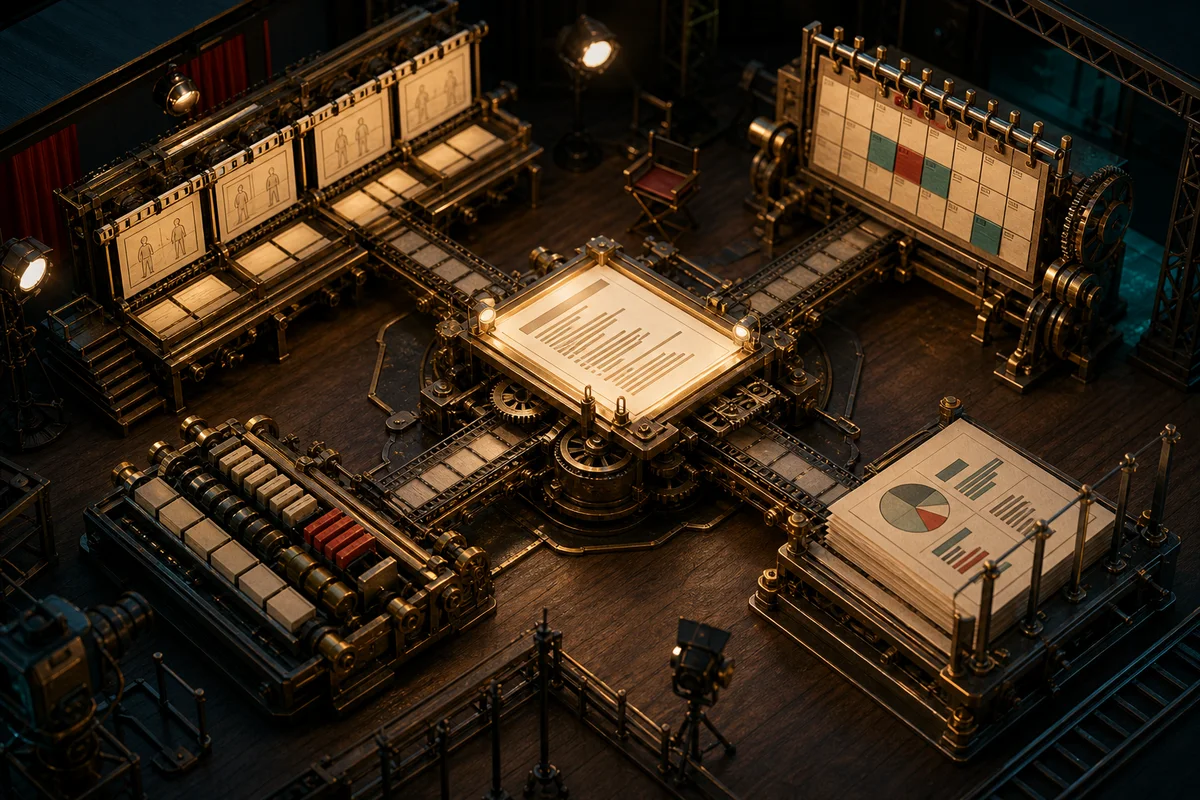
A dashboard can gather four modules into one screen and still show four different versions of reality. If each module stores its own idea of a scene, customer, order, or cost, the interface only places the contradictions closer together. A single source of truth begins with shared entities, explicit relationships, and controlled state changes. It is a data-model decision before it is a reporting feature.
A dashboard cannot repair disconnected entities
Teams often discover fragmentation through small symptoms. A name is corrected in one place but remains wrong in an export. A scheduled item has a different status in the operations view. A budget total changes without showing which source record moved. The natural response is another synchronization job or a consolidated dashboard.
Synchronization can move data, but it cannot decide which record is authoritative. That choice belongs in the domain model. For every important concept, the team should know where its identity is created, which service owns changes, and which other views derive from it. Copies used for search or performance need a defined refresh rule and a path back to the source.
StoryXen gives this problem a concrete shape. The Alfcode product connects script breakdowns, storyboards, schedules, budgets, and investor-ready reporting for film production. Those are not simply neighbouring tabs. They are different views of the same production work, and their value depends on shared entities staying connected as the plan changes.
Model the dependency chain
Start with the relationship that creates the operational consequence. In a film planning product, a script contains scenes. A scene breakdown identifies cast, props, locations, and other requirements. Scheduling assigns that work to production days. Resource and time decisions affect costs and reports. The useful model preserves those links rather than copying free-text descriptions between modules.
Stable identifiers matter more than matching labels. Two scenes may have similar names. A location may be renamed after the schedule is built. A character's display name may change without creating a new character. Relationships based on identifiers survive those edits and allow each interface to show the current label.
Ownership should be narrow. The script module can own the script revision and scene identity. The breakdown can own the classified requirements attached to a scene. Scheduling can own the assignment of scenes and resources to a day. Budgeting can own cost assumptions while referencing the work that produced them. Shared truth does not mean one oversized table that every feature can update.
State transitions provide the other half of the model. A scene moving from planned to scheduled, or a production day becoming locked, should be an explicit operation with rules and an actor. If any form can replace a status value directly, downstream features cannot know whether to recalculate, warn, or preserve an approved result.
Derived values need provenance
Many values in connected software are calculated rather than entered. A budget total may depend on a schedule version, resource rates, quantities, and manual adjustments. A report may summarize the current plan or a plan that was approved last week. Showing the number without its lineage creates the appearance of a source of truth while removing the evidence behind it.
The W3C PROV data model defines provenance around the entities, activities, and people involved in producing a piece of information. A product does not need to implement that specification to use the principle. For each consequential derived value, preserve the source records, relevant versions, calculation or transformation, actor, and time.
This makes recalculation a deliberate product decision. A live planning estimate may update whenever its inputs change. An approved report may need to remain attached to the exact version that was reviewed. Both can exist in one system if the interface labels them clearly and the model does not overwrite the approved evidence with the latest value.
Provenance also makes discrepancies actionable. Instead of telling a producer that the schedule and budget differ, the product can point to the changed scene, resource, rate, or production day. The user can correct the source or accept a new version rather than manually reconciling two totals.
Corrections should propagate without erasing history
A source of truth is not a record that never changes. It is a controlled history of what the product currently believes and how that belief changed. Corrections should update dependent current views while preserving consequential versions that people previously approved or shared.
Choose propagation behaviour by dependency. A spelling correction can usually appear everywhere immediately. Removing a scene from a locked production day may require a warning and a new schedule revision. Changing a rate after a budget was approved may update the working estimate while leaving the approved report intact. The model should express these differences instead of asking every screen to invent them.
Events and versions can work together. Events record the actions that occurred. Versions capture a coherent state that can be reviewed, approved, exported, or compared. Not every keystroke needs a permanent version, but every transition that changes a decision should leave enough evidence to reconstruct it.
Avoid circular ownership. If a schedule updates a breakdown total and that total silently reschedules the scene, the product has no clear authority. Derived data can trigger a suggestion or validation warning, but the action that changes an owned record should pass through the component responsible for it.
Test the model with real production changes
Entity diagrams look convincing until a realistic revision moves through the system. Test the model with scenarios that cross module boundaries:
- split one scene into two after the first breakdown
- replace a location after resources were assigned
- move work to another day after a budget was approved
- change a rate for future work without rewriting an old report
- restore an earlier plan while keeping newer notes available
For each scenario, ask which entity changes, which views update automatically, which approved artifacts remain fixed, and what the user sees before committing the change. Any answer that depends on manually updating another module points to a missing relationship or transition.
The same review applies beyond production software. Inventory, compensation, logistics, and client portals all depend on shared operational entities. The nouns change, but the design question remains: can one controlled change produce every appropriate downstream view without destroying the evidence people already relied on?
A useful single source of truth is not a large database or one universal dashboard. It is a network of clearly owned records, stable relationships, explicit state changes, and derived values with provenance. Once those foundations are present, each interface can show the part of reality its user needs without creating a competing version of it.
Have a product decision to make?
Tell us what you are building. We will help turn the hard parts into a clear plan.
Keep reading.
Retryable workflows need idempotency people can see
Safe automation gives each intent one identity, records every attempt, exposes partial outcomes, and lets operators retry without repeating the effect.
Read
Prove native behavior before choosing a mobile stack
A thin proof on physical devices can expose platform limits early, turning stack selection from preference into an evidence-based decision.
Read